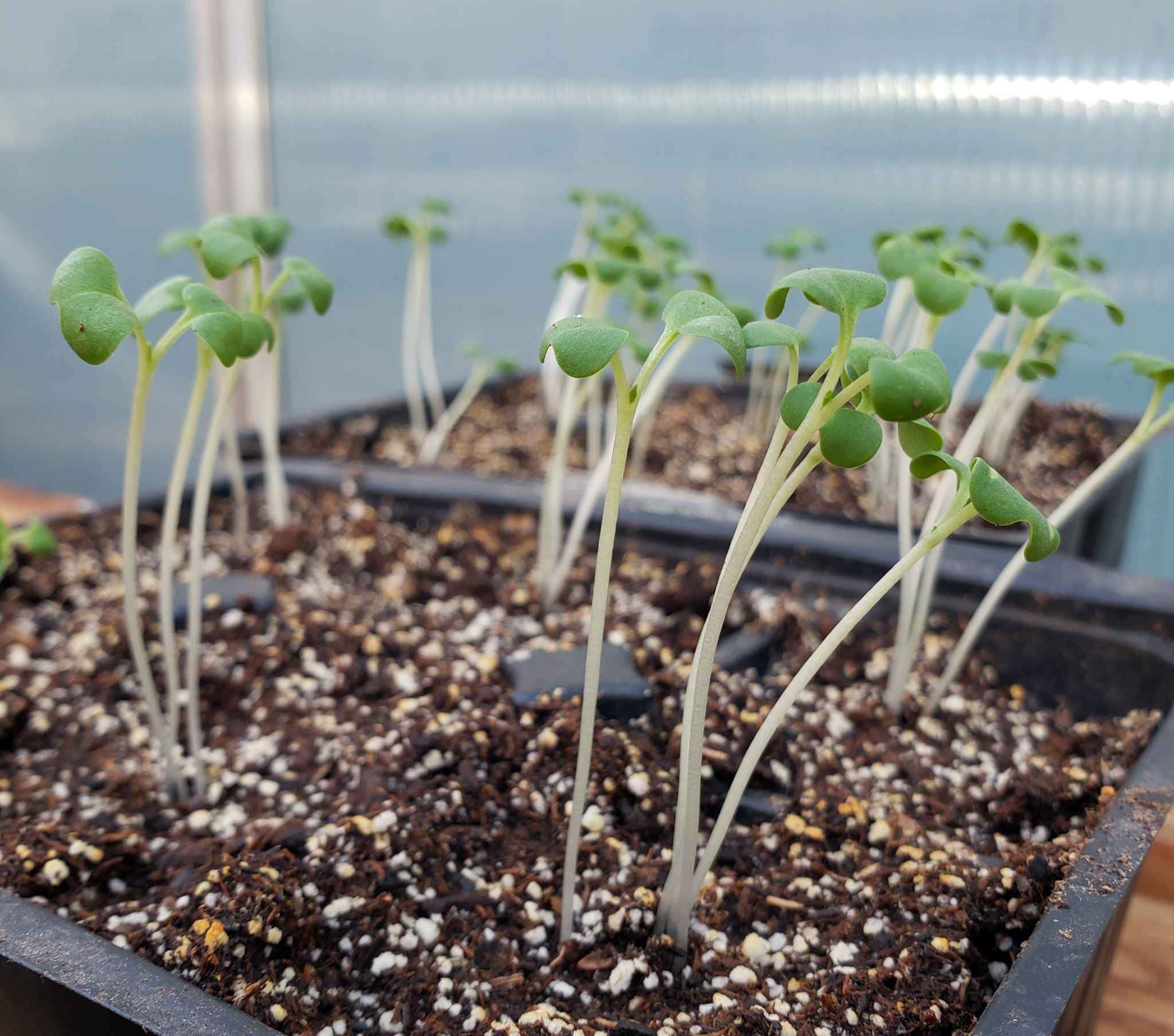
Watching seeds sprout is one of the best moments of the gardening year—until those promising green shoots shoot straight up into pale, thread-thin stems that flop over the edge of the tray. In gardening, this stretched, top-heavy growth is known as etiolation, though most growers simply call it leggy seedlings.
When a seedling stretches upward too quickly, it pours all its limited seed energy into stem length rather than building thick cell walls, strong roots, or sturdy true leaves. Left uncorrected, leggy seedlings snap easily in a light breeze, struggle to transplant outdoors, and often succumb to stem rot. The good news is that once you understand why seedlings stretch, you can salvage many of them immediately and keep your next tray compact and stocky.
How to Spot Leggy Seedlings Early
A healthy vegetable seedling should look stocky, upright, and deeply colored, with short gaps (internodes) between its leaves. Watch for these early signs of trouble:
-
Long, pale, pencil-thin stems: A big gap of bare stem between the soil line and the first pair of seed leaves (cotyledons).
-
Leaning or bending toward a window: Stems that curve sharply in one direction as the plant reaches for a distant light source.
-
Small, widely spaced true leaves: Foliage looks pale yellow-green rather than rich green, and leaves sit far apart up the stem.
-
Top-heavy flopping: Stems bend over under the weight of their own leaves or collapse after a gentle misting.
Leggy Growth vs. Damping-Off Disease
It is critical not to confuse weak, stretched stems with damping-off, a deadly fungal disease that strikes seedlings at the soil line:
What Actually Causes Seedlings to Stretch?
Seedlings stretch because their internal growth hormones respond to light, temperature, and competition:
1. Not Enough Light (or Light Positioned Too Far Away)
This is the primary trigger. Even a bright south-facing windowsill (north-facing in Australia) delivers only a fraction of outdoor sunlight—and glass filters out even more intensity. When a seedling senses low light, it assumes it is shaded by competing weeds and elongates rapidly to reach the sun. Similarly, hanging shop lights or grow lights even 20 to 30 cm (8 to 12 inches) too high forces seedlings to stretch toward the bulbs.
2. Room Temperatures That Are Too Warm After Germination
Seeds need warmth to germinate—many vegetables sprout fastest at 21°C to 27°C (70°F to 80°F). However, the moment green shoots break the soil surface, they need cooler temperatures. Keeping sprouted seedlings on a heat mat or in a warm room drives rapid, soft stem growth that outpaces what indoor light can support.
3. Overcrowded Trays
Sowing seeds too thickly forces neighboring sprouts to compete for light from day one, triggering an upward race that leaves every seedling thin and weak.
4. Lack of Gentle Air Movement
Outdoors, wind and rain constantly nudge young stems, prompting plants to produce ethylene, a natural hormone that makes stems grow thicker and stronger (a response called thigmomorphogenesis). Still indoor air leaves stems soft and unconditioned.
5. Leaving Humidity Domes On Too Long
Plastic dome lids keep seeds moist during germination, but leaving them on after sprouting blocks light, traps excess heat, and creates stagnant, overly humid air that encourages weak growth and fungal disease.
Diagnosing Your Setup in Two Minutes
Check these four things on your seed-starting bench right now:
-
Measure the light gap: If using grow lights, how far are the bulbs from the tops of the leaves? For standard LED or fluorescent shop lights, anything more than 5 to 10 cm (2 to 4 inches) is usually too far.
-
Check the heat mat: Are sprouted trays still sitting on bottom heat?
-
Look at the stem base: Is the stem simply tall and bent, or is it pinched and dark brown right where it meets the compost?
-
Count seedlings per cell: Are three or four sprouts crammed into a single plug?
How to Rescue Leggy Seedlings (By Plant Type)
Whether you can fix a leggy seedling depends heavily on its plant family:
1. Deep-Planting Crops (Tomatoes, Tomatillos, and Peppers)
Tomatoes are uniquely forgiving because they grow adventitious roots anywhere their stem touches moist soil.
-
Wait until seedlings develop their first set of true leaves.
-
Gently lift each seedling by its leaves (never squeeze the fragile stem) and pot it up into a deeper container, burying the stem all the way up to just below the lowest set of leaves.
-
Peppers, eggplants, and brassicas (cabbage, broccoli, kale) do not root along their stems as aggressively as tomatoes, but burying them slightly deeper up to their seed leaves still stabilizes wobbly stems.
2. Fragile-Stemmed Crops (Cucurbits, Lettuce, and Root Crops)
Squash, cucumbers, melons, lettuce, and beets have hollow or delicate stems that rot easily if buried deeply.
-
Slightly stretched: Immediately move them closer to bright light, lower the room temperature, and add gentle airflow.
-
Severely stretched and bent over: It is usually faster and more productive to sow a fresh batch under brighter light than to nurse damaged, kinked stems.
3. Thin Crowded Cells Immediately
Do not pull extra seedlings out of a crowded cell—yanking disturbs the tangled roots of the keeper. Instead, use small, clean scissors to snip off the weaker extras right at the soil line.
Step-by-Step Prevention for Your Next Sowing
-
Remove humidity domes and heat mats at germination. As soon as roughly 50% of the seeds have sprouted, take off the clear cover and turn off bottom heat (unless growing heat-lovers like peppers in a cold basement).
-
Drop the temperature slightly. Most seedlings grow stockiest at daytime temperatures around 15°C to 21°C (60°F to 70°F) and slightly cooler nights.
-
Keep grow lights close and on a timer. Position full-spectrum LED or T5 fluorescent lights 5 to 10 cm (2 to 4 inches) above the leaf tips—raising the lights as the plants grow—and run them for 14 to 16 hours a day (plants still need 8 hours of darkness to rest).
-
Rotate windowsill trays daily. If growing by a window without grow lights, turn trays 180 degrees every morning and prop a piece of white cardboard or foil behind the tray to bounce light back onto the shaded side of the stems.
-
Brush stems or run a small fan. Set an oscillating fan on low across the room so leaves rustle gently for a few hours a day, or lightly brush your hand across the tops of sturdy seedlings (like tomatoes and brassicas) once or twice daily to mimic outdoor breezes.
-
Water from the bottom and skip early fertilizer. Let the surface of the seed-starting mix dry slightly between bottom waterings, and wait until true leaves appear before applying a quarter- or half-strength liquid fertilizer.
Regional Seed-Starting Tips
-
USA & Canada: Starting seeds indoors in February or March means fighting short northern days and cold window glass. Supplemental LED shop lights are almost essential for stocky transplants, and remember to harden seedlings off gradually outdoors for 7 to 10 days before planting out after your last spring frost.
-
UK: Cool, overcast late-winter days make windowsill seed starting challenging, especially in heated rooms. Using an unheated greenhouse, cold frame, or bright conservatory once seeds germinate—alongside modern peat-free seed composts—prevents rapid indoor stretching.
-
Australia: In mild-winter coastal and northern regions, most vegetables can be sown directly outdoors or raised in bright, sheltered shade-houses rather than indoors. If starting seeds inside during winter in southern states (like Victoria or Tasmania), give seedlings maximum winter sun and protect them from cold glass at night.
Common Mistakes to Avoid
-
Fertilizing leggy seedlings to “strengthen” them: High-nitrogen fertilizer accelerates soft, watery stem growth and makes legginess worse.
-
Leaving grow lights on 24 hours a day: Seedlings need a dark period for normal cellular processes; continuous light causes leaf yellowing and stress.
-
Using heavy garden soil in seed trays: Garden soil compacts, drains poorly, and harbors damping-off fungi. Always use a clean, fine-textured seed-starting mix.
-
Applying fungicides to stretched stems: Legginess is a light and temperature issue, not a disease—chemical sprays will not shorten or thicken a stretched stem.
When to Seek Local Gardening Help
If seedlings repeatedly collapse at the soil line across clean trays and fresh potting mix—or develop distorted, discolored leaves despite bright light and proper temperatures—contact your local university extension office or Master Gardener helpline (USA and Canada), the Royal Horticultural Society (RHS) advisory service (UK), or state agricultural departments and specialist nurseries (Australia) for help diagnosing seed-borne diseases or contaminated growing media.
Frequently Asked Questions
Can leggy seedlings recover and produce a normal harvest?
Yes, if caught early. Tomatoes, peppers, and brassicas potted deeper and moved under bright, cool conditions quickly build thick stems and strong roots, yielding just as well as stocky seedlings.
How close should grow lights be to vegetable seedlings?
For standard cool-running LED or fluorescent shop lights, keep the bulbs 5 to 10 cm (2 to 4 inches) above the tops of the seedlings. If using high-intensity commercial LED grow panels, follow the manufacturer’s hanging height (typically 30 to 45 cm / 12 to 18 inches) so leaves do not bleach or scorch.
Should I bury leggy cucumber or squash seedlings deeper?
No. Cucurbits have tender, hollow stems that are prone to stem rot if buried deeply. If they are only slightly stretched, support them gently and move them into brighter light; if they are severely bent or kinked, sow fresh seeds.
Why did my seedlings grow tall overnight?
Rapid overnight stretching usually happens when seeds germinate on a warm heat mat or under a closed humidity dome in the dark. Removing the dome and moving the tray straight under bright lights the moment sprouts appear prevents that sudden surge.
Reliable Sources and Further Reading
-
University of Minnesota Extension – Starting Seeds Indoors for guidance on grow light height, post-germination temperatures, airflow, and potting up leggy seedlings.
-
Royal Horticultural Society (RHS) – Growing From Seed and Damping Off for UK-focused seed-starting practices, peat-free composts, and distinguishing damping-off from cultural stretching.
-
Clemson Cooperative Extension (HGIC) – Starting Seeds Indoors for light duration, temperature management, and hardening off transplants.
