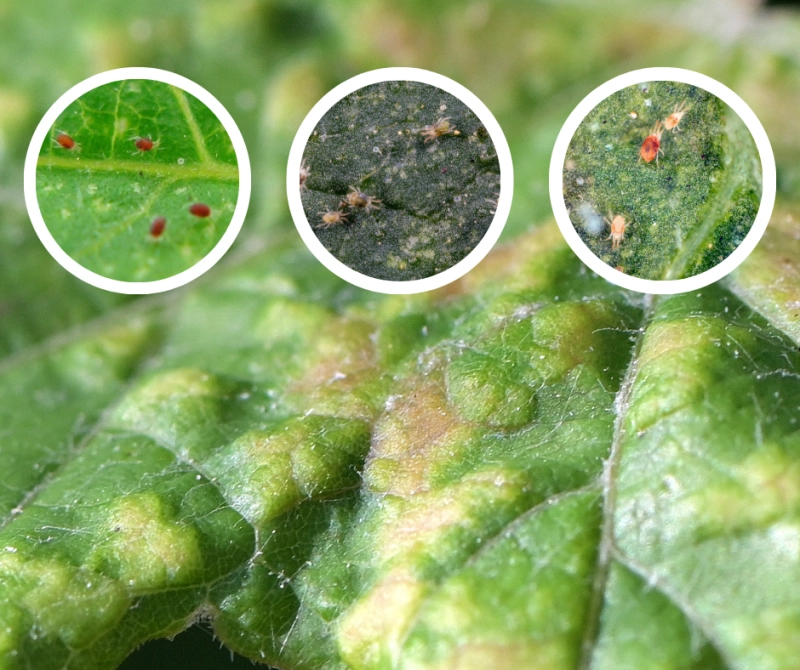
A fine, pale speckling across the upper surface of tomato, bean, or rose leaves—often mistaken at first glance for sun scorch, nutrient deficiency, or dust—is the classic calling card of spider mites. Unlike insects, spider mites belong to the arachnid family Tetranychidae, measuring less than 0.5 millimeters (about the size of a grain of fine pepper). Using needle-like stylets, they puncture individual leaf cells from the underside and drain the chlorophyll-rich contents, leaving behind thousands of microscopic white or yellow dots known as stippling.
Because spider mites thrive in hot, dry, and dusty conditions, an outbreak can escalate rapidly during midsummer heatwaves or inside warm greenhouses and heated indoor rooms. At temperatures above 27°C (80°F), species such as the two-spotted spider mite (Tetranychus urticae) complete a full generation from egg to reproductive adult in as little as five to seven days—meaning early detection is essential before foliage turns bronze, dries out, and drops.
Diagnostic Inspection: Confirming Spider Mites
Because individual mites are nearly invisible to the naked eye, reliable diagnosis relies on checking leaf undersides and performing a simple physical test rather than waiting until heavy webbing blankets the plant.
1. Look for Early Foliage Changes
Inspect the lower and middle leaves first, especially along the main leaf veins where mites shelter and feed:
-
Upper leaf surface: Pinpoint yellow, white, or silvery-tan stippling that gradually merges into a dull, bleached, or bronzed appearance.
-
Lower leaf surface: Tiny moving dots (pale green, yellow, orange, or red depending on the species and diet), cast white skins, and tiny black fecal specks.
-
Silken webbing: Fine, gossamer threads stretched between leaf lobes, petioles, and stem tips. Visible webbing indicates an established, high-density colony that requires immediate intervention.
2. Perform the White Paper Shake Test
Hold a clean sheet of white printer paper or a white paper plate directly beneath a symptomatic branch. Tap the stem firmly two or three times so debris falls onto the surface. Watch the tiny specks closely for 10 to 15 seconds: soil dust and dried pollen stay motionless, whereas spider mites begin crawling slowly across the page. Smearing the specks with a finger leaves faint reddish-brown or greenish streaks.
Distinguishing Spider Mite Damage from Look-Alikes
Treating a plant for mites when another pest or environmental stress is responsible wastes effort and can harm beneficial predators. Compare the symptoms carefully before applying any treatment.
| Observed Symptom | Spider Mite Indicator | Look-Alike Condition to Rule Out |
| Speckled or bleached upper leaves | Uniform, pinpoint stippling with no shiny black droppings and fine webbing underneath. | Thrips or lace bugs: Produce larger, irregular silvery patches accompanied by shiny black, tar-like fecal spots on leaf undersides. |
| Fine silk webbing on foliage | Delicate, tight webbing hugging leaf undersides and shoot tips; tiny mites crawling inside. | True garden spiders: Construct structured, geometric orb or funnel webs spanning wide gaps between branches without causing leaf stippling. |
| Bronzed, dry, curling leaves | Starts on lower or inner foliage during hot weather; undersides feel slightly gritty. | Drought stress or heat scorch: Affects outer, sun-exposed leaf margins first without pinpoint stippling or underside debris. |
| Yellowing leaves with sticky residue | Spider mites produce zero honeydew; leaves remain dry and dusty. | Aphids, whiteflies, or soft scale: Excrete sticky, sugary honeydew that attracts ants and encourages black sooty mold. |
Common Garden Spider Mite Species
-
Two-spotted spider mite (Tetranychus urticae): The most widespread species across North America, Europe, and Australia; pale yellow-green with two dark spots visible along the sides of its oval body, turning orange-red when overwintering. Feeds on vegetables, berries, roses, fruit trees, and houseplants.
-
Spruce spider mite (Oligonychus ununguis): A cool-season mite active primarily in spring and autumn rather than midsummer; attacks conifers such as spruce, fir, juniper, and arborvitae, turning needles mottled gray-brown.
-
European red mite (Panonychus ulmi): Brick-red with white bristles along its back; overwinters as bright red eggs on the bark of apples, pears, plums, and ornamental woody shrubs.
Why Outbreaks Flare Up in Hot, Dry Weather
Spider mites reproduce fastest when humidity drops below 40% and daytime temperatures remain high. Dry, dusty garden paths and drought-stressed plants create ideal microclimates: dust settling on leaf undersides shields mites from small predators, while water-stressed plants concentrate higher levels of soluble amino acids in their sap, boosting mite fertility.
Just as importantly, broad-spectrum insecticides—particularly pyrethroids (such as permethrin, bifenthrin, and cypermethrin) and carbaryl—do not kill spider mites effectively. Instead, they wipe out natural predators such as predatory mites (Phytoseiulus persimilis, Amblyseius spp.), minute pirate bugs (Orius spp.), and lady beetle larvae (Stethorus spp.), triggering explosive secondary mite outbreaks within weeks.
Step-by-Step Treatment Plan
Controlling spider mites requires breaking their rapid reproductive cycle. Because most contact treatments kill active nymphs and adults without penetrating unhatched eggs, you must apply treatments in a planned sequence spaced 5 to 7 days apart for at least two to three cycles.
Step 1: Prune Heavily Webbed Foliage
Snip off severely bronzed, heavily webbed leaves and terminal shoots using clean secateurs. Place the trimmings directly into a sealed rubbish bag rather than an open compost pile so mites cannot crawl back onto neighboring beds.
Step 2: Knock Down Colonies with Directed Water Sprays
Before using any spray product, take potted plants outdoors or use a garden hose fitted with a firm spray nozzle to blast the undersides of all leaves early in the morning. Water pressure physically dislodges mites, breaks up protective webbing, and raises local humidity, slowing reproduction. Repeat this thorough rinsing every two to three days for two weeks.
Step 3: Apply Targeted, Low-Impact Miticides
When water sprays alone cannot contain an active infestation—especially on dense shrubs, fruit trees, or indoor collections—apply a contact miticide directly to both upper and lower leaf surfaces until dripping:
-
Insecticidal soap (potassium salts of fatty acids): Dissolves the outer protective cuticle of active mites on contact, causing rapid dehydration while leaving zero toxic residue once dry.
-
Horticultural oils (narrow-range mineral oil or clarified hydrophobic extract of neem oil): Smothers active mites and coats eggs to prevent hatching. Never apply oils when temperatures exceed 29°C (85°F), in direct midday sun, on drought-stressed plants, or within two to four weeks of a sulfur spray.
-
Wettable sulfur: Effective against many spider mite species on hardy ornamentals and select vegetables, though strictly avoid using it on sulfur-sensitive plants (such as apricots, viburnums, and certain cucurbits) or during hot weather.
Always verify that your chosen product is approved for your specific ornamental or edible crop in your region (such as the EPA in the US, HSE in the UK, PMRA in Canada, or APVMA in Australia), and follow all label instructions regarding dilution rates and pre-harvest intervals.
Step 4: Introduce Predatory Mites in Greenhouses or Gardens
For persistent infestations in greenhouses, polytunnels, or high-value garden beds where harsh sprays are undesirable, release commercially reared predatory mites such as Phytoseiulus persimilis (which specializes in two-spotted spider mites in warm, humid conditions) or Neoseiulus californicus (which tolerates hotter, drier environments). Ensure no residual sprays have been applied for at least two weeks before releasing beneficial predators.
Long-Term Prevention Habits
Keeping spider mites from returning relies on making the garden environment less hospitable to dry-weather pests:
-
Water consistently at the root zone: Keep garden beds mulched with 5 to 8 centimeters (2 to 3 inches) of organic compost, bark, or straw to conserve soil moisture and prevent dust from kicking up onto lower leaves during wind or watering.
-
Rinse foliage periodically during dry spells: A weekly morning misting or hose rinse of susceptible outdoor plants—such as roses, runner beans, and dwarf conifers—washes away leaf dust and disrupts early mite colonization before webbing forms.
-
Quarantine new arrivals: Isolate newly purchased houseplants or nursery perennials for two to three weeks and inspect their leaf undersides with a 10x hand lens before placing them beside established plants.
Frequently Asked Questions
Can spider mites live in potting soil after I throw away an infested plant? Spider mites feed exclusively on living green plant tissue rather than decaying organic matter in soil. However, adult females can crawl onto pot rims, saucers, windowsills, or nearby weeds to survive between hosts. Scrub empty pots and surrounding surfaces thoroughly with hot, soapy water before reusing them.
Do spider mites bite humans or infest household furniture? No. Plant-feeding spider mites cannot bite humans or pets and do not infest carpets, bedding, or upholstery. Occasionally, people notice tiny red clover mites (Bryobia praetiosa) crawling on sunny exterior walls or windowsills in spring—these feed on lawn grasses and clover and are harmless to people, though crushing them leaves a red stain.
Why did spider mites appear on my indoor plants during winter? Central heating dramatically lowers indoor relative humidity—often dropping below 20%—while keeping room temperatures warm. These dry, warm conditions mimic summer drought outdoors, allowing dormant or newly introduced mites to multiply rapidly on houseplants such as palms, calatheas, crotons, and English ivy.
Sources and Further Reading
-
University of California Statewide Integrated Pest Management Program (UC IPM): Spider Mites Management Guidelines — https://ipm.ucanr.edu/PMG/PESTNOTES/pn7405.html
-
Royal Horticultural Society (RHS): Glasshouse Red Spider Mite — https://www.rhs.org.uk/biodiversity/glasshouse-red-spider-mite
-
Colorado State University Extension: Spider Mites (Fact Sheet 5.507) — https://extension.colostate.edu/topic-areas/insects/spider-mites-5-507/
-
Government of Western Australia, Department of Primary Industries and Regional Development (DPIRD): Two-Spotted Mite — https://www.agric.wa.gov.au/pest-insects/two-spotted-mite
