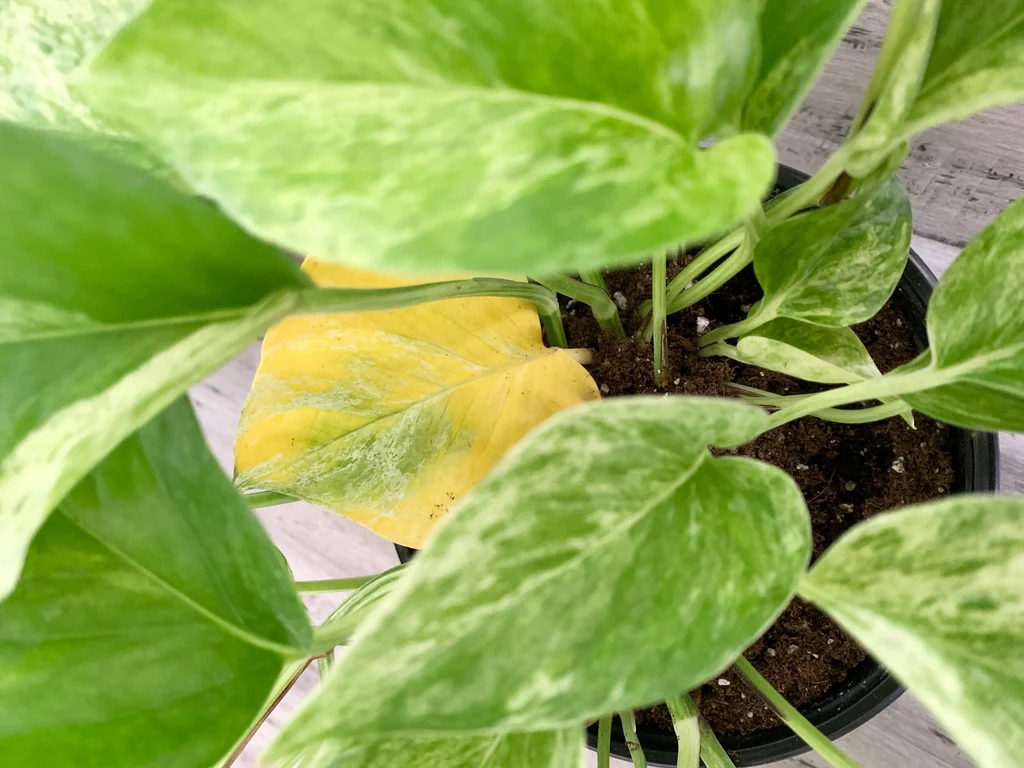
Common Signs and Symptoms of Yellowing Leaves
-
Soft, limp yellow leaves on the lower stem: Often paired with heavy, damp potting mix and occasionally a musty smell near the base. This typically points to excess moisture and poor root aeration.
-
Dry, papery, or crispy yellow leaves: Yellowing starts at the tips or margins and turns brown and brittle. The potting mix usually pulls away from the sides of the pot.
-
Yellowing restricted to one or two oldest leaves: The rest of the plant remains firm, upright, and continues producing healthy new growth. This is usually natural leaf aging (senescence).
-
Yellow leaves with green veins (interveinal chlorosis): When this appears on new upper growth, it commonly indicates an iron or micronutrient issue, often linked to soil pH. When it appears on older lower leaves, magnesium deficiency is more likely.
-
Pale, bleached, or washed-out yellowing on the sun-facing side: Leaves look faded rather than richly yellow, sometimes with dry, tan scorch patches. This signals too much direct light.
-
Stippled, speckled, or mottled yellow patches: Tiny pale dots across the leaf surface, sometimes accompanied by fine webbing, sticky residue (honeydew), or small bumps along stems, point to sap-sucking pests.
-
Sudden yellow leaf drop without other rot symptoms: Often follows a rapid change in location, temperature, or airflow—especially common in ficus species (Ficus benjamina, Ficus lyrata) and citrus grown indoors.
Main Causes of Yellow Leaves on Indoor Plants
1. Watering Imbalances and Poor Drainage
-
Succulents, snake plants (Dracaena trifasciata), and ZZ plants (Zamioculcas zamiifolia) store water in their leaves or rhizomes and require gritty, fast-draining mixes that dry completely between waterings.
-
Ferns, calatheas (Goeppertia), and peace lilies (Spathiphyllum) prefer evenly moist—never soggy—mixes and quickly develop yellow or crispy margins if allowed to go bone dry.
-
Growing medium differences matter regionally: In the UK, houseplant growing media are commonly called houseplant compost or potting compost (soilless mixes, distinct from garden-waste compost), and peat-free coir or wood-fiber formulations are now standard. Peat-free mixes often dry out quickly on the surface while staying wet deeper in the pot, making finger-testing essential. In the US, Canada, and Australia, standard potting mix is frequently peat- or bark-based; chunky aroid mixes dry much faster than dense all-purpose blends.
2. Light Stress (Too Little or Too Much)
3. Natural Aging (Senescence)
4. Nutrient Deficiencies and Soil pH
-
Nitrogen deficiency causes uniform yellowing starting on older, lower leaves because nitrogen is mobile—the plant moves it to support new leaves.
-
Iron deficiency causes yellowing between the veins on the newest leaves because iron is immobile in plant tissue.
-
Magnesium deficiency shows up as interveinal yellowing on older leaves.
5. Root-Bound Containers
6. Temperature Drafts, Heating, and Humidity
7. Sap-Sucking Pests
8. Tap Water Quality and Salt Buildup
How to Identify the Exact Cause
| Observation | Check Next | Most Likely Cause |
| Soft, limp yellow lower leaves | Feel soil 5 cm (2 in) down; check pot weight and roots | Overwatering or poor drainage |
| Dry, brittle yellow leaves or tips | Check if soil is dry and shrunken from pot walls | Underwatering or root-bound pot |
| Yellowing only on 1–2 oldest bottom leaves | Check if new growth is healthy and firm | Natural aging (senescence) |
| Yellowing with green veins on new leaves | Review feeding history and tap water hardness | Iron deficiency or high soil pH |
| Uniform yellowing on older leaves, slow growth | Check last repotting or fertilizing date | Nitrogen deficiency |
| Pale, bleached yellow patches on window-facing side | Note hours of direct sun hitting the leaves | Direct sun / light scorch |
| Yellow speckling, sticky leaves, or fine webbing | Inspect undersides of leaves and stem joints with a magnifier | Spider mites, thrips, scale, or mealybugs |
| Sudden yellowing after moving pot or season change | Check nearby vents, radiators, or cold windowpanes | Temperature draft or acclimation shock |
Step-by-Step Practical Solutions
If the Plant Is Overwatered
-
Pause watering immediately and empty any standing water from saucers or decorative cachepots.
-
Inspect the roots if the potting mix is waterlogged or smells sour. Trim away mushy, dark roots using clean, sharp scissors or pruners wiped with rubbing alcohol.
-
Repot into fresh, airy potting mix suited to the species (for example, adding perlite or fine bark for tropical foliage plants, or coarse grit for succulents) in a container with unobstructed drainage holes.
-
Adjust watering habits going forward: water only when the top 2.5–5 cm (1–2 in) of mix feels dry for most tropicals, or when the pot dries completely for succulents.
If the Plant Is Underwatered or Root-Bound
-
Rehydrate thoroughly by bottom-watering—set the pot in a basin of room-temperature water for 20–30 minutes until the surface feels damp, then let excess water drain completely. Dry peat- or coir-based mixes become water-repellent (hydrophobic) and often shed water poured from above.
-
Check root density. If roots are densely coiled, repot into a container just 2.5–5 cm (1–2 in) wider in diameter. Jumping into a pot that is far too large leaves excess wet mix around the roots and invites rot.
If Light Is the Problem
-
Too little light: Move the plant closer to a brighter window (east- or west-facing windows suit most indoor foliage plants; in Australia, north-facing windows receive the most winter sun, while in the Northern Hemisphere south-facing windows do). If natural light is scarce in winter, supplement with a full-spectrum LED grow light placed 20–45 cm (8–18 in) above the canopy for 10–12 hours daily.
-
Too much direct sun: Pull the plant back 1–2 meters (3–6 feet) from the glass or filter harsh rays with a sheer curtain.
If Nutrients or Salt Buildup Are Responsible
-
Flush (leach) the potting mix first if you see a white mineral crust or suspect salt buildup: slowly run room-temperature water equal to roughly twice the pot’s volume through the soil in a sink or tub, allowing it to drain completely.
-
Feed lightly only during active growth (spring through early autumn). Use a balanced liquid houseplant fertilizer diluted to half the label strength if the plant has not been fed or repotted in over a year. Do not fertilize dormant winter plants or stressed plants with damaged roots.
-
Refresh the mix if the potting medium is more than 2–3 years old, compacted, or alkaline from hard water.
If Pests Are Present
-
Isolate the affected plant immediately to stop pests from spreading to neighboring houseplants.
-
Start with physical removal: Rinse sturdy leaves under a lukewarm shower stream to dislodge spider mites and aphids, or dab visible mealybugs and scale with a cotton swab dipped in 70% isopropyl alcohol.
-
Use targeted, low-toxicity treatments only if needed: Potassium salts of fatty acids (insecticidal soap) or horticultural oil (including neem-based products where approved) can control soft-bodied pests when sprayed thoroughly on leaf undersides. Always test on a single leaf first, keep treated plants out of direct sun until dry, and follow the product label exactly. Pesticide approvals vary by region—use only products registered for indoor ornamental plants under local regulations (EPA in the US, HSE in the UK, PMRA in Canada, and APVMA in Australia).
What to Do With Already-Yellow Leaves
Common Mistakes to Avoid
-
Watering on a fixed calendar schedule: A plant’s water use changes with daylight, indoor heating, air-conditioning, and season. Always check the potting mix rather than watering automatically every Sunday.
-
Fertilizing a sick plant: Fertilizer is not medicine. Adding soluble salts to a plant stressed by root rot, drought, or cold shock burns weakened roots and worsens yellowing.
-
Planting in pots without drainage holes: Putting gravel or pebbles at the bottom of a sealed pot does not create drainage; it raises the saturated water layer closer to the roots. Always keep the plant in a pot with drainage holes, even if you slip it inside a decorative outer pot.
-
Misting to fix dry air: Occasional misting raises humidity only for minutes and can encourage leaf spots on fuzzy-leaved plants like African violets (Streptocarpus) or begonias. Grouping plants or running a cool-mist humidifier is far more effective for humidity-sensitive species.
-
Moving a plant repeatedly: Shifting a stressed plant to a new room every few days prevents it from acclimating and can prolong leaf drop.
How to Prevent Yellow Leaves Going Forward
-
Match the plant to your light, not the other way around. Reserve dim corners for tolerant species such as cast iron plant (Aspidistra elatior), ZZ plant, or pothos (Epipremnum aureum), and keep light-hungry plants like fiddle-leaf figs (Ficus lyrata) or citrus near bright windows.
-
Adjust care with the seasons. In the UK, Canada, and northern US, cut back watering and stop fertilizing from late autumn through winter as growth slows. In Australia, make the same seasonal slowdown during May through August, and guard against harsh afternoon sun and drying air-conditioning in summer.
-
Use the right potting mix for the plant type. Refresh compacted mixes every 1–2 years for fast-growing foliage plants so roots stay well-aerated.
-
Inspect new plants before bringing them home. Check leaf undersides, stem joints, and the soil surface, and keep new arrivals separated from existing plants for 2–3 weeks to catch hidden pests early.
-
Use rainwater or filtered water for sensitive species. If your tap water is heavily mineralized or fluoridated and you grow calatheas, dracaenas, or spider plants, switching to rainwater or distilled water prevents recurring tip burn and yellowing.
When Professional Gardening Advice May Be Needed
-
Multiple plants of different species yellow simultaneously despite different watering routines (which can point to an environmental factor such as a gas leak, water supply issue, or widespread thrips/mite infestation).
-
You see black, sunken stem lesions, oozing sap, or concentric leaf spots that spread rapidly—signs of bacterial or fungal diseases that do not respond to watering adjustments.
-
A large, valuable, or sentimental specimen (such as a mature indoor palm, citrus tree, or bonsai) continues declining after repotting and light correction.
Frequently Asked Questions
Should I cut yellow leaves off my indoor plant?
Can yellow leaves turn green again?
Why are only the bottom leaves turning yellow?
Why did my plant’s leaves turn yellow right after I repotted it?
Getting Your Plant Back on Track
Reliable Sources and Further Reading
-
Royal Horticultural Society (RHS) — Houseplants: Common Problems and Care Guides (UK guidance on watering, peat-free houseplant composts, light levels, and indoor pests)
-
University of Minnesota Extension — Houseplant Care and Diagnosing Houseplant Problems (Research-based guidance on chlorosis, watering, light, and pest management)
-
Clemson Cooperative Extension (Home & Garden Information Center) — Indoor Plant Diseases and Cultural Disorders (Detailed breakdowns of physiological disorders, root rot, and water quality sensitivity)
-
University of Maryland Extension — Common Houseplant Pests and Cultural Problems (Diagnostic criteria for overwatering, salt buildup, and sap-sucking insects)
-
ABC Gardening Australia — Indoor Plant Care and Troubleshooting Guides (Southern Hemisphere seasonal adjustments, indoor light orientation, and potting mix advice)
-
Master Gardeners of Ontario / Agriculture and Agri-Food Canada — Indoor Gardening and Houseplant Pest Management Resources (Cold-climate winter care and Canadian pest-control guidance)
